

A surprise vet bill can be one of the most stressful parts of owning a dog, and pet insurance is meant to soften the blow. Whether it’s worth it for your dog depends on your budget, your dog’s health today, and the fine print in the policy.
This guide explains how dog insurance works, what it usually covers and leaves out, what it costs on average, and how to decide for your own situation.
Quick answer: Pet insurance can be worth it for some dog owners, but it isn’t the right fit for everyone. It tends to make the most sense if a large, unexpected vet bill would strain your budget and your dog is healthy enough to qualify for useful coverage. Policy terms, exclusions and waiting periods decide how much it actually helps.
The American Veterinary Medical Association (AVMA) says there is no magic formula that tells you whether pet insurance is right for your pet. Its advice is to talk with your veterinarian and compare your options carefully.
When Pet Insurance Tends to Make Sense (and When It May Not)
These are general decision factors, not rules. Your own numbers matter more than any average.
It may make more sense if:
- A large, unexpected vet bill would be hard to absorb without borrowing or going into debt.
- Your dog has no diagnosed health conditions right now, so fewer things will be excluded.
- You prefer a predictable monthly cost over the risk of one big bill.
It may make less sense if:
- You could comfortably pay a major vet bill from savings.
- Your dog already has conditions that a policy would likely exclude.
- The premium, which can rise over time, would stretch your budget.
How Pet Insurance for Dogs Works
Most pet insurance works by reimbursement. You pay the veterinarian first, send in a claim, and the insurer pays back part of the eligible costs. The Illinois Department of Insurance warns that insurance isn’t guaranteed to save you money, and some owners end up paying more in premiums than they receive in benefits. Most providers let you see any licensed vet, including specialists and emergency clinics.
Four terms decide how much you actually get back:
- Premium: what you pay monthly or yearly to keep the policy.
- Deductible: the amount you pay before reimbursement starts. It can be annual or per condition.
- Reimbursement rate: the percentage of eligible costs the insurer pays after the deductible. It is typically somewhere between 60% and 100%, though some plans use a fixed benefit schedule instead.
- Limits: a cap per incident, per year, or over your dog’s lifetime.
A simple example (hypothetical, not a real claim):
| Step | Amount |
|---|---|
| Vet bill | $1,500 |
| Minus annual deductible | −$250 |
| Eligible amount | $1,250 |
| Insurer pays 80% | $1,000 |
| You pay (deductible + 20%) | $500 |
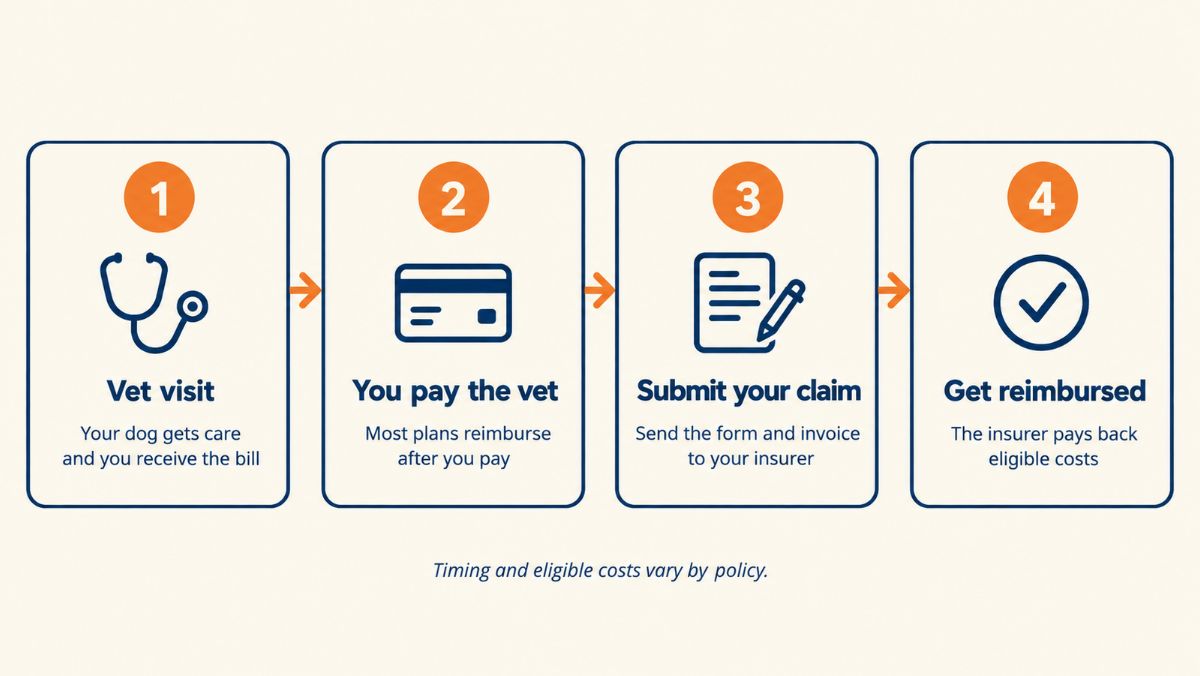
How a typical reimbursement claim works.
In real life, some insurers calculate payments from “usual and customary” fees, which can make the eligible amount lower than your actual bill. Always check how your policy calculates claims.
[Image 2: four-step diagram, vet bill → you pay → submit claim → reimbursement]
What Dog Insurance Usually Covers
According to the North American Pet Health Insurance Association (NAPHIA), an industry trade group, plans generally come in three flavors:
| Plan type | What it generally includes |
|---|---|
| Accident-only | Injuries such as swallowed objects, cuts, car accidents, ligament tears and poisoning |
| Accident and illness | Accident coverage plus illnesses such as cancer, infections and digestive problems |
| Wellness add-ons | Routine care such as vaccines or screening, which may be built in or sold separately |
Illness coverage can include diagnostics, medication, lab tests, surgery and hospital stays for categories such as digestive, ear, eye, nervous system and infectious diseases, as well as cancer.
It helps to know which problems dogs actually get. In NAPHIA’s 2026 State of the Industry report, 2025 North American claims data from member companies lists digestive problems, ear infections, skin conditions, behavioral and neurological issues, and allergies among the most common conditions for dogs. It reflects only the companies that contributed data, but it gives a realistic picture of everyday claims.
Coverage works best when you know what illnesses are realistic, so our complete guide to common dog diseases is a good place to start. Skin problems and ear infections show up often in claims data, and allergies are an example of an ongoing condition, so it helps to understand dog skin diseases before you compare plans.
What Dog Insurance Usually Doesn’t Cover
Policies have exclusions, and they are where most disappointment comes from. Common ones include:
- Pre-existing conditions: problems that began before coverage started, or during the waiting period.
- Hereditary or congenital conditions: most companies treat these as pre-existing, so check how your policy words it.
- Cosmetic or elective procedures, such as ear cropping, unless medically necessary.
- Other exclusions: policy wording varies, so read the exclusions section before you buy.
Routine wellness and preventive care is usually a separate, optional coverage that some insurers offer and others don’t. If you’re budgeting for routine care, our dog vaccination schedule shows what a typical year of preventive care involves, and you can compare that against any wellness add-on you’re offered.
Pre-Existing Conditions, Waiting Periods and Chronic Conditions
These three terms cause the most confusion, so here they are in plain language.
Pre-existing conditions. The National Association of Insurance Commissioners (NAIC), a body of state insurance regulators, wrote a Pet Insurance Model Law that states can adopt. It defines a pre-existing condition as one where, before the policy began or during a waiting period, a vet gave advice about it, the pet was treated for it, or there were signs directly related to it. Under that model, a covered condition can’t be treated as pre-existing at renewal, and the insurer must prove an exclusion applies.
Waiting periods. This is the time after you buy before some coverage starts. The Illinois Department of Insurance describes typical ranges of 2 to 14 days for accidents and 14 to 30 days for illness. The NAIC model would cap illness waiting periods at 30 days, let you waive them with a vet exam, and ban waiting periods for accidents altogether, which shows how much the rules can differ by state and by policy. Your actual policy decides.
Take parvo as an example. Under the NAIC definition, a condition that shows signs during a waiting period counts as pre-existing, and our guide to parvo in dogs lists the symptoms that need a vet right away. Whether a given policy covers a vaccine-preventable disease can also depend on that policy’s wording, so check it before you rely on it.
Chronic conditions. The NAIC model defines a chronic condition as one that can be treated or managed but not cured. Under the model, an insurer that excludes chronic conditions must say so up front. The practical question is whether ongoing conditions stay covered from year to year. The Illinois Department of Insurance suggests asking about “continuous coverage,” because some companies treat a condition from a previous policy term as pre-existing when the policy renews. Allergies and osteoarthritis are examples of conditions that can last beyond a single policy year.
Rules vary by state. The NAIC model is a template, not a national law. As of March 2026, 16 jurisdictions had adopted it, so protections and wording differ depending on where you live.
If your dog is already sick. Call your vet first. Our checklist of signs your dog is sick can help you judge how urgent it is. A condition that already has signs or a diagnosis is likely to be excluded, so insurance is mainly useful for problems that start after your coverage begins.
How Much Does Pet Insurance Cost for Dogs?
According to NAPHIA’s 2026 State of the Industry report, which covers 2025 U.S. data, the average annual premiums for dogs were:
| Plan type | Average annual premium (2025) |
|---|---|
| Accident and illness | $836 (about $70 a month) |
| Accident-only | $190 |
| Insurance with embedded wellness | $1,414 |
The accident-and-illness average was up 11.5% from the year before. These are industry-wide averages across all ages, breeds and locations, so your quote could be higher or lower. Premiums can depend on your dog’s age and breed, insurers may adjust pricing for where you live, and the deductible, reimbursement rate and limits you choose can change the price too. The AVMA advises asking how premiums will increase as a pet ages or after you make claims.
A quick way to sense the long-term cost (illustration only): at a flat $836 a year, ten years of premiums would be $8,360. Real premiums change over time, so treat this as a rough yardstick, not a forecast. The Illinois Department of Insurance suggests a similar exercise: add up the policy’s cost over your dog’s expected life and compare it with what you could afford to pay for an emergency or a long illness.
Pet Insurance vs. Saving Your Own Money
Some owners skip insurance and set aside money each month instead. Both approaches have trade-offs:
| Pet insurance | Self-funding | |
|---|---|---|
| Cost pattern | Predictable premiums | Irregular, depends on what happens |
| Protection from a large bill | Yes, subject to limits and exclusions | Only as much as you’ve saved |
| Pre-existing conditions | Usually excluded | Not an issue |
| Money you don’t use | Not returned | Stays yours |
If you’re worried about paying upfront in an emergency, the AVMA suggests asking your vet about payment options ahead of time, so you aren’t arranging payment during a crisis.
Questions to Ask Before You Buy
The Illinois Department of Insurance recommends shopping for coverage, not just the lowest price. Before you commit, ask:
- Can I use any licensed vet, including specialists and emergency clinics?
- What is covered, and what is excluded?
- Are there per-incident, annual or lifetime limits?
- Will I be reimbursed by a percentage or by a benefit schedule?
- How long are the waiting periods, and can they be waived with an exam?
- How are pre-existing, hereditary and chronic conditions handled?
- Is coverage continuous for ongoing conditions?
- How long do claims take, and is there a deadline to submit them?
- What are the age limits for enrolling and for renewing?
Get more than one quote using the same deductible and limits, and read the sample policy, not just the marketing page. Some states also require a “free look” period for reviewing and returning a new policy. The NAIC model sets it at 15 days, but your state’s rules and your insurer’s terms apply.
Is It Worth It for Your Dog? A Quick Checklist
There’s no score here. If most answers are “yes,” insurance may deserve a closer look.
- Would a large, unexpected vet bill be hard for me to pay?
- Is my dog free of diagnosed conditions today?
- Can I afford the premium now and as it may rise?
- Am I comfortable paying the vet first and waiting for reimbursement?
- Have I read the exclusions and waiting periods?
- Do I prefer a predictable monthly cost to saving on my own?
Frequently Asked Questions
Is pet insurance worth it for a healthy young dog?
It can be, because insurance is meant for unexpected problems, and a dog with no diagnosed conditions has fewer exclusions to worry about. It isn’t automatic, though. The AVMA advises asking how premiums will rise as your dog ages, so look at long-term costs, not only the first-year price.
Does pet insurance cover pre-existing conditions?
Usually not. These are often excluded permanently or temporarily. The Illinois Department of Insurance notes that some companies may cover a condition that has been cured and treatment-free for at least six months, so read the policy’s exact wording.
How long are waiting periods?
They vary. Typical ranges are 2 to 14 days for accidents and 14 to 30 days for illness, and your state’s rules may limit them. Check your policy before assuming coverage has started.
Can I buy pet insurance after my dog gets sick?
Often yes, though availability depends on the insurer. The condition that already appeared is likely to be treated as pre-existing and excluded, so check how the policy handles it.
Does pet insurance cover vaccines and routine care?
Not by default. Routine wellness and preventive care is typically an optional add-on, and not every insurer offers it.
Does the insurer pay the vet, or do I?
Most plans reimburse you after you’ve paid the clinic. Ask any provider how claims are processed and how long reimbursement takes.
The Bottom Line
Pet insurance is a way to turn an unpredictable vet bill into a predictable monthly cost, with limits and exclusions attached. It is not a guaranteed saving. It tends to work best for owners who would struggle with a large unexpected bill, who enroll before health problems appear, and who read the policy carefully.
If you’re still unsure, start by comparing a few quotes and asking your vet what is realistic for your dog’s breed and age.
How we prepared this article: We built this guide from veterinary, regulatory and industry sources, including the AVMA, the Illinois Department of Insurance, the NAIC and NAPHIA. No insurance company or affiliate sponsors this page, and it contains no affiliate links (some other PetGlowGuide pages do, for unrelated products). Policies, prices and state rules change, so confirm details in the policy documents. Data was last reviewed in October 2026. This article is general information, not financial, legal or veterinary advice.
Share :

numan anwar
Pet care enthusiast sharing practical, well-researched guides to help dog and cat owners make confident everyday decisions.
Leave a comment