

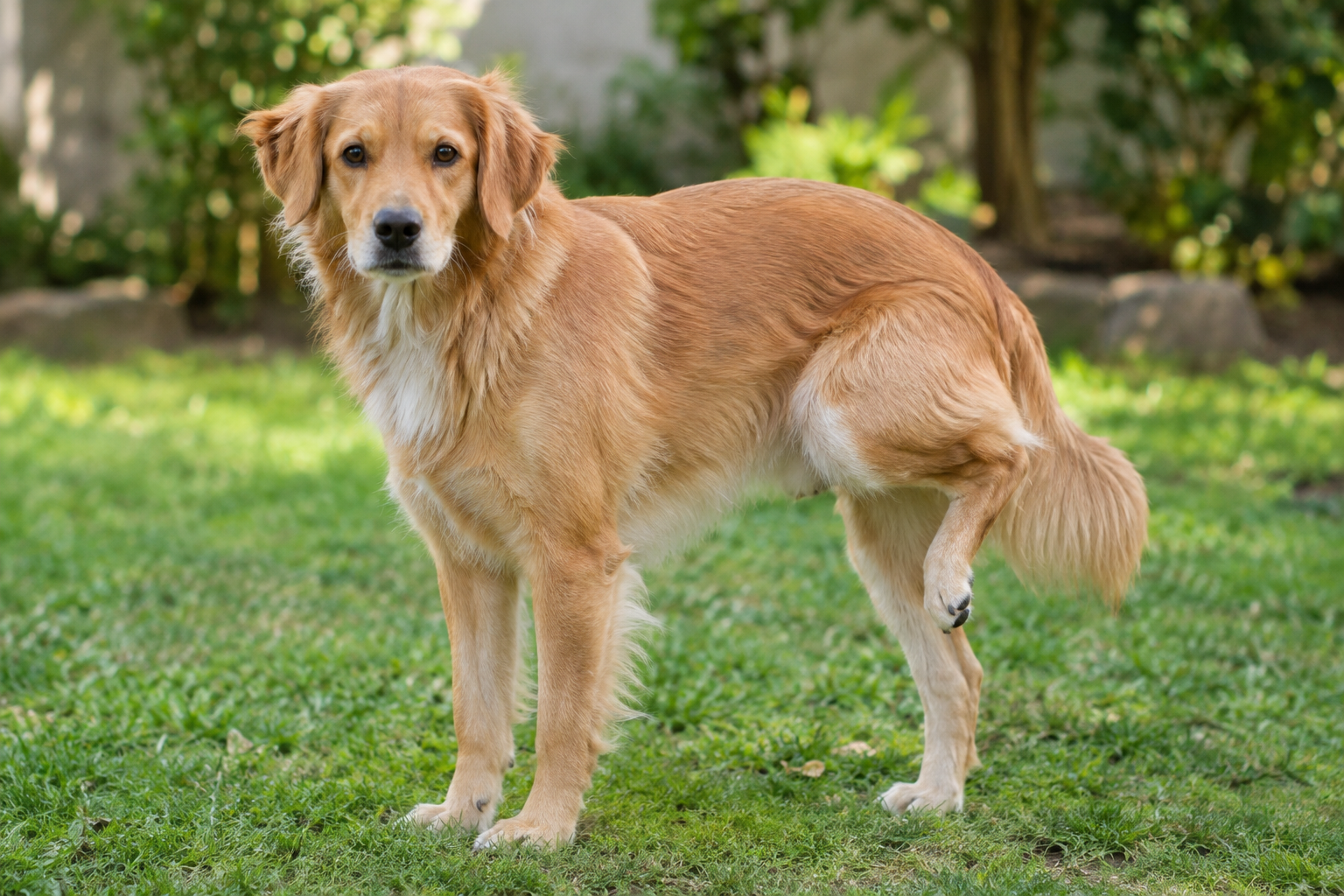
General information for dog owners. This article cannot diagnose your dog and does not replace a veterinary exam.
Seeing a dog limping on a back leg is worrying, especially when you do not know what happened. Sometimes the cause is minor, like a thorn in a paw. Other times it is a painful injury or joint problem that needs treatment. This guide covers the common causes of back leg limping, the signs that mean you should act quickly, what you can safely do at home, and how to prepare for your vet visit.
Quick answer: Limping usually means pain or weakness, so it deserves veterinary attention. Go to a vet right away if you see any of the urgent signs below. If you do not, call your vet instead of waiting it out, especially if the limp lasts more than a day or two or is getting worse.
When to See a Vet
| What you see | What to do |
|---|---|
| A dangling limb, swelling, a hot leg, or an obvious break or unnatural angle | Get veterinary care right away |
| A limp that lasts more than a day or two, pain that is severe, sudden or getting worse, or a dog that will not put weight on the leg | Call your vet and do not wait it out |
The American Kennel Club lists a dangling limb, swelling, a hot limb and an obvious break or unnatural angle as signs that need immediate care. Cornell University’s College of Veterinary Medicine advises against waiting if a limp has lasted more than a day or two or if the pain is severe, sudden or getting worse.
If your dog is limping and also seems off in other ways, our guide to other warning signs that your dog may be sick can help you decide what to do next.
What Limping on a Back Leg Means
Limping means something painful or weak is interfering with normal use of the leg. Lameness, the veterinary term, ranges from mild stiffness to being unable to put any weight on the leg, and it can involve muscles, joints, bones or even the nervous system. Because dogs cannot tell us where it hurts, a veterinary exam is how the source of the pain is found.
Vets look at your dog’s age, size and breed, and at which leg is affected, because front leg and back leg problems tend to have different common causes.
Terms you may hear
- Lameness: the veterinary word for limping.
- Stifle: a dog’s knee joint.
- Cranial cruciate ligament: a ligament in the knee that connects the thigh bone to the shin bone. It is similar to the ACL in people.
Sudden vs. Gradual Limping
Knowing how the limp started helps your vet narrow down the possible causes.
| Sudden limp | Gradual limp | |
|---|---|---|
| How it starts | Quickly | Slowly over time |
| What it is usually linked to | An injury or trauma | A long-term or degenerative condition, such as osteoarthritis or dysplasia |
| How serious it can be | Minor or severe, depending on the cause | Should still be checked, not put off |
A gradual limp is not a reason to wait. The AKC notes that some causes of gradual limping, such as hip dysplasia and bone cancer, can be treated more effectively when they are caught sooner.
Common Causes of Back Leg Limping
The causes below are common possibilities, not a complete list. More than one problem can be present at the same time, especially in older dogs. Limping can also be one sign of a wider health problem. For a broader overview, see our guide to common dog diseases.
Paw and foot problems
Thorns, glass, nails, sticks and other things lodged in a paw can make walking painful and may lead to infection. Insect stings or bites, cuts, broken toenails, burns and bruising can also cause limping. Constant licking of one paw can be a clue that something is wrong there.
Knee (cruciate ligament) injury
In older dogs with back leg lameness, a torn cranial cruciate ligament is the most common cause according to Cornell. A dog may suddenly be unable to put weight on the leg, and the knee may feel swollen or unstable.
Unlike many human knee injuries, a torn ligament in a dog is rarely just the result of one accident. As the University of Florida’s Small Animal Hospital explains, the ligament often weakens over time, and a tear can then happen during everyday activity such as running or jumping. The problem is often present in both knees. A partial tear may seem better with rest while the ligament keeps weakening, so a limp that improves is not proof that the problem has gone away.
Joint problems
Older dogs may limp because of hip arthritis. Our guide to arthritis in dogs explains the signs to watch for, such as stiffness and slowness getting up. In young dogs, hip dysplasia is the most common cause of back leg lameness, and it is more common in larger breeds. It can make stairs, jumping and getting into the car difficult. Other causes in young dogs include a dislocating kneecap (luxating patella), growing-pain conditions and tendon or muscle injuries.
Other serious causes
Bone cancer and spinal disease are among the other possible causes of back leg lameness in older dogs. Bone cancer needs prompt diagnosis for the best outcome. Infections such as Lyme disease can also cause joint pain and limping, which is one reason to keep your dog on an effective tick preventive.
Most of these causes cannot be told apart by looking at your dog, which is why a veterinary exam matters.
What You Can Safely Check at Home
You can gently run your hand down your dog’s leg and paw to feel for swelling, heat or tenderness. Notice whether your dog keeps licking the paw. What you find can help your vet judge how urgently your dog needs to be seen.
Do not test your dog’s range of motion or bend and twist the leg. Without training, this can injure your dog further.
While You Wait for Your Appointment

Keep your dog calm and avoid exercise or play, which can make the limp worse. If you need to drive to the clinic, a crate in the car can help prevent further injury.
Do not give your dog any pain reliever, including human ones, before talking to your vet. The FDA advises talking to your veterinarian before giving a dog any pain reliever, including human products such as ibuprofen, naproxen and aspirin. Dogs can process these drugs differently than people do, which can cause serious side effects. The FDA also warns that acetaminophen can cause liver damage in dogs. No over-the-counter NSAIDs for dogs are FDA-approved, and the FDA-approved NSAIDs for dogs are available only by veterinary prescription. That includes leftover medication prescribed for another pet.
What Your Vet Will Do
Your vet will ask about the limp, watch how your dog walks and trots, and examine the spine and each leg and joint. This exam looks at the bones, joints, muscles and ligaments, and at the nerves and spinal cord. Depending on what the exam shows, your vet may recommend X-rays, CT or MRI, bloodwork or joint fluid testing. Your vet will also go over treatment options and cost estimates with you.
What to write down before you go
Vets usually start with questions like these, as Cornell outlines. Jotting down the answers beforehand makes the visit more useful:
- The date the limp began, and whether it started suddenly or slowly
- Whether it is improving, worsening, or switching legs
- Any difficulty on stairs, when jumping, standing up, or during exercise
- Any recent injury, hard activity, or change in routine
- Medicines your dog has had, and whether they seemed to help
Film a short video
Some dogs move normally at the clinic because of excitement or adrenaline. A short video of your dog walking at home, showing the limp, can give your vet information the exam may miss.
Treatment Depends on the Cause
There is no single treatment for a limp. Depending on the cause, your vet may recommend pain control, rest and activity restriction, weight management, physical rehabilitation, or surgery or a referral to a specialist. Sometimes treatment is as simple as a few days of rest, but in other cases it involves medication, further testing or a long recovery. In most cases, the sooner your dog is seen, the better the outlook.
Do not start any medication on your own. Your vet can choose a treatment that is safe for your dog.
FAQs
Can a dog’s limp go away on its own?
Sometimes a mild limp improves, but that does not tell you the cause. A partial cruciate tear can look better with rest while the ligament keeps weakening, and some causes of gradual limping are treated more effectively when found early. If the limp lasts more than a day or two, call your vet.
Can I give my dog ibuprofen or other human pain relievers?
No. Talk to your veterinarian first. The FDA warns that pain relievers made for people may not be safe for dogs and can cause serious side effects, and that acetaminophen can damage a dog’s liver.
Is a dog limping on a back leg an emergency?
Not always, but it can be. A dangling limb, swelling, a hot leg, or an obvious break or unnatural angle need immediate veterinary care. For other limps, call your vet rather than waiting it out.
The Bottom Line
A dog limping on a back leg can have causes ranging from a thorn in a paw to a torn knee ligament. You cannot tell which at home, so let your vet find the cause. Get care right away for the urgent signs above, call your vet for a limp that lasts or is getting worse, keep your dog calm until the visit, and do not give any pain reliever, including human ones, unless your vet says it is safe. A short video and a few notes about when the limp started will help your vet get to the answer faster.
Sources
- What to expect when taking your limping dog to the veterinarian, Cornell University College of Veterinary Medicine
- Why Is My Dog Limping?, American Kennel Club
- Cranial Cruciate Ligament Rupture, University of Florida Small Animal Hospital
- Get the Facts about Pain Relievers for Pets, U.S. Food and Drug Administration
Share :

numan anwar
Pet care enthusiast sharing practical, well-researched guides to help dog and cat owners make confident everyday decisions.
Leave a comment