

This post contains affiliate links. If you buy through them, we may earn a commission at no extra cost to you.
If you’ve ever watched your big cat hang half their body out of the litter box, you already know the problem: most litter boxes just aren’t built for large cats. They’re sized for an “average” cat that doesn’t look much like a Maine Coon, a Ragdoll, or any other big-bodied breed.
Here’s how to actually size a litter box for a large cat, what the research says about covered vs. open designs, and what to check before you buy — including one enclosed, metal-base option to consider.
Why Most Litter Boxes Are Too Small for Big Cats
Most commercial litter boxes are designed around an average-sized cat, not a large one. That mismatch is the root cause behind a lot of “my cat won’t use the litter box” problems.
The general sizing guideline used by feline behaviorists is that a litter box should be at least 1.5 times the length of your cat, measured from the tip of the nose to the base of the tail (not including the tail itself). For a typical adult cat, that works out to a box around 24 inches or longer.
Large-breed cats change that math significantly. Maine Coons, Ragdolls, and Norwegian Forest Cats can measure 20 inches or more just from nose to tail base — which pushes the ideal box length to 30 inches or beyond. The catch: most litter boxes labeled “extra-large” in stores only reach about 24 to 26 inches. A box marketed as “large” can still be too small for an actual large cat, so it pays to check dimensions rather than trust the label.
How to Size a Litter Box for Your Cat
The 1.5× Body-Length Rule
Measure your cat standing naturally, from the tip of the nose to the base of the tail (skip the tail itself — it doesn’t need to fit inside the box). Multiply that number by 1.5. That’s your minimum box length.
This rule shows up consistently across multiple independent cat-care sources, which is a good sign it reflects real behaviorist consensus rather than one site’s guess — though no single, universally-cited peer-reviewed paper anchors the exact multiplier.
Quick Size Reference
| Cat Size | Typical Body Length | Minimum Box Length |
|---|---|---|
| Small/average cat | 12–16 in | 18–24 in |
| Average adult cat | 16–18 in | 24–27 in |
| Large breed (Maine Coon, Ragdoll, Norwegian Forest Cat) | 18–20+ in | 30+ in |
Width matters too — aim for at least a few inches wider than your cat’s body so they can turn around comfortably, and don’t forget headroom if you’re considering a covered box.
Covered vs. Open Litter Boxes — What the Research Actually Shows
This is the part people tend to have strong opinions about, so let’s look at the actual evidence instead of marketing claims either way.
A peer-reviewed study published in the Journal of Feline Medicine and Surgery tested 28 cats with a choice between a covered and an uncovered box. The result: there was no statistically significant difference in usage between the two styles overall. A minority of individual cats — 8 out of 28 — did show a personal preference (split roughly evenly between covered and uncovered), which suggests some cats care and some genuinely don’t.
In practical terms: for most cats, a clean covered box isn’t automatically worse than an open one.
A few caveats matter here, though:
- Odor control cuts both ways. Some veterinary commentary notes that covered boxes can trap ammonia odor inside more than open designs do, especially if cleaning is delayed.
- Individual cats vary. Feline behaviorists have pointed out that studies like this one used unusually large test boxes and daily cleaning — conditions that don’t always match real households. If a covered box is smaller than recommended or cleaned less often, some cats may be more likely to avoid it.
- Shy or anxious cats can go either way. A covered box can feel like a safe, private den for some cats — and too enclosed or unpredictable for others.
Bottom line: a covered box is a reasonable, evidence-backed choice for most cats — as long as it’s genuinely large enough inside and you keep up with cleaning. It’s not automatically the wrong call, but it’s also not a guaranteed fix if your cat already has litter box issues.
What to Check Before Buying a Large Cat Litter Box
Interior Floor Space vs. “Large” Marketing Labels
Don’t rely on the word “large” or “jumbo” on the packaging. Check the actual interior dimensions against your cat’s measured body length using the 1.5× rule above. Covered boxes especially can look big on the outside while the actual usable floor space inside is smaller once you account for the hood and entryway.
Entry and Hood Height Clearance
For a covered box, make sure your cat can stand up and turn around without their back brushing the roof. A cramped hood can be just as much of a problem as a small floor.
Material
Litter box bases come in a few common materials:
- Plastic — lightweight, affordable, but can scratch over time, and scratches can hold odor
- Metal/stainless steel base — generally more scratch-resistant and easier to wipe clean than plastic. We couldn’t find strong independent research comparing long-term odor retention between the two, so treat this as a practical observation, not a proven fact
- Hybrid designs (metal base + plastic hood) — common in enclosed boxes; check which parts are metal and which are plastic rather than assuming the whole unit matches the marketing name
Ease of Cleaning, Odor Control, and Included Accessories
Look for a low-friction cleaning routine (removable trays, wide scooping access), and check whether a scoop and mat are included — both make day-to-day maintenance easier, especially with the larger litter volume a big-cat box requires.
Featured Pick: Enclosed Stainless-Steel-Base Litter Box for Large Cats
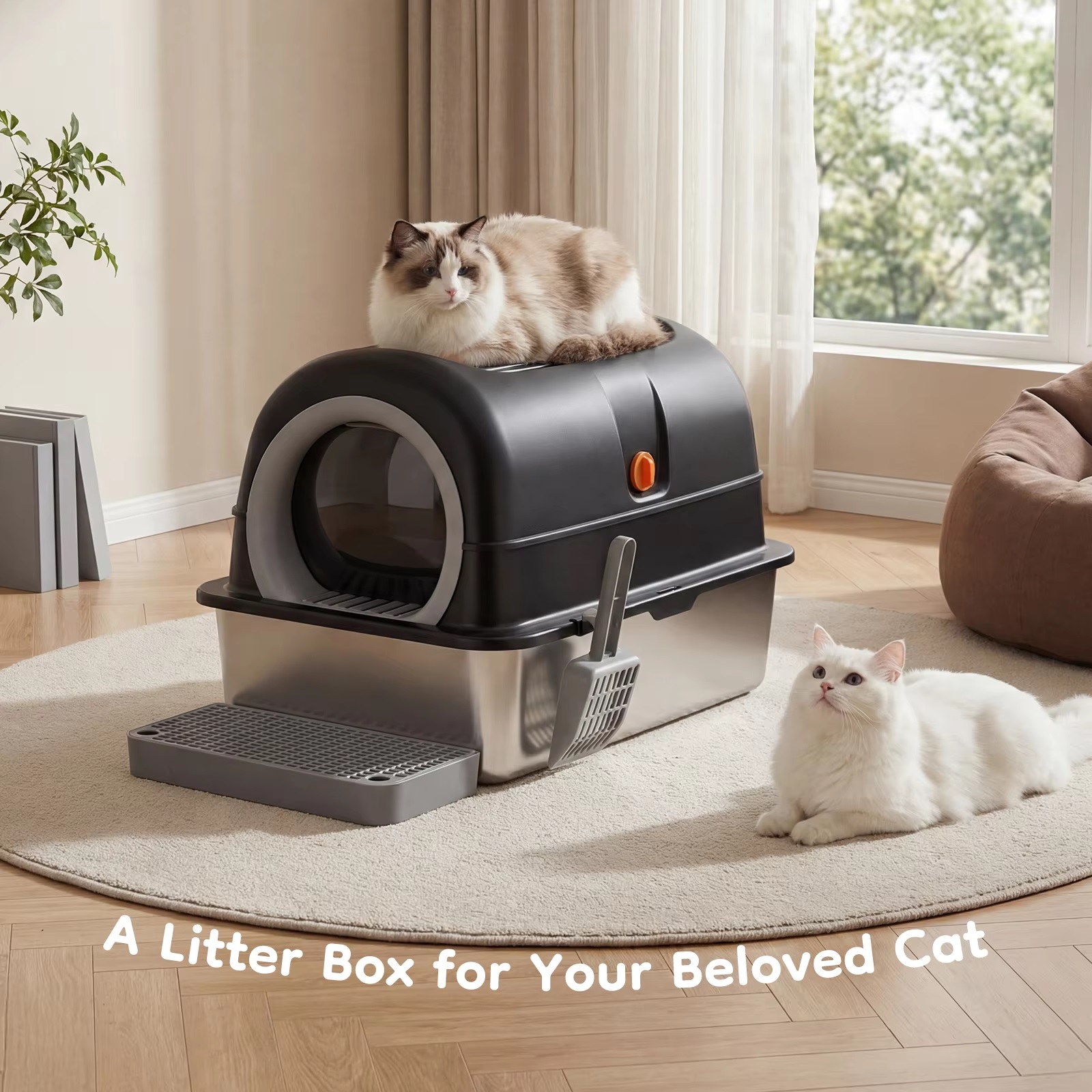
One enclosed option in this category has a metal base,is listed by the seller as roughly 24 inches with a 30-liter capacity, and comes with a scoop and litter mat included.
Check the current price and product details →
Based on the product photos, the lower tray/base has a stainless-steel-look metal finish, while the domed hood is molded plastic — so despite “stainless steel” appearing in the product name, it’s more accurate to call this a metal-base, plastic-hood design rather than an all-steel unit. We couldn’t independently verify the exact interior dimensions or capacity through the retailer’s listing, so treat those numbers as seller-stated and double-check them against your own cat’s measurements before buying.
What stands out from the photos:
- Rounded, walk-in style entry with a raised threshold, which can help catch some tracked litter
- A vented top panel/knob, which may help with airflow (design purpose not independently confirmed)
- Included scoop that clips to the side of the unit, and a separate textured step mat in front
Who it may suit: owners of large-breed cats who want a covered box with easier-to-clean surfaces than plain plastic, and who don’t mind a design that leans more heavily covered/enclosed than an open pan.
Who it may not suit: owners of cats with an established preference for open boxes, or households that can’t commit to at least daily scooping, since enclosed designs can hold odor longer if cleaning slips.
[Product image and affiliate link would go here in the final published version]
Other Types to Consider
Open-top large litter boxes — Typically offer more usable interior space for the same footprint since there’s no hood eating into the layout, and airflow is naturally better. A good fit if your cat has shown a preference for open designs, or if odor control matters more to you than mess containment.
Self-cleaning litter boxes — A different category entirely, aimed at owners who want automated waste removal instead of manual scooping. These cost significantly more and work best for cats comfortable with mechanical movement and noise nearby. Not the focus of this guide, but worth a look if convenience is your top priority.
FAQ
What size litter box does a large cat need? Using the 1.5× body-length rule, most large-breed cats (Maine Coons, Ragdolls, Norwegian Forest Cats) need a box around 30 inches or longer for ideal comfort, though many commercial “extra-large” boxes only reach 24–26 inches.
Are covered litter boxes bad for large cats? Not necessarily. Peer-reviewed research on covered vs. uncovered boxes found no significant overall usage difference when boxes were kept clean, though individual cats can have their own preference. The bigger risk with large cats specifically is a covered box being too small inside, not the fact that it’s covered.
Is stainless steel better than plastic for a litter box? Metal bases are generally easier to wipe clean and more scratch-resistant than plastic, which likely helps with odor control over time — though this is a practical observation, not a settled research finding.
How many litter boxes should I have for one large cat? This comes up often in cat-care guidance, but we don’t have a strongly sourced number to give here. Check with your vet or a feline behavior resource for guidance specific to your household.
What is the biggest litter box you can buy? This varies by retailer and changes over time, so rather than naming a specific “biggest” product, focus on interior dimensions relative to your own cat’s measured body length using the sizing guide above.
Final Verdict
If you have a large-breed cat and standard boxes keep coming up too small, prioritize interior floor space above everything else — the label “large” isn’t a guarantee. A covered, metal-base design like the one featured here can be a solid pick if you want easier cleanup than plain plastic and your cat doesn’t have a strong preference for open boxes, as long as the interior space genuinely fits the 1.5× rule and you keep up with regular cleaning.
Share :

numan anwar
Pet care enthusiast sharing practical, well-researched guides to help dog and cat owners make confident everyday decisions.
Leave a comment